
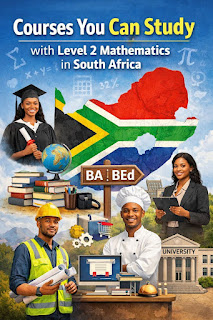

Courses You Can Study with Level 2 Mathematics in South Africa
In South Africa, Mathematics performance plays a significant role in determining access to higher education. Learners who obtain Level 2 in Mathematics (30–39%) are often led to believe that their academic and career options are severely limited. This perception, while understandable, is incomplete. Although certain fields such as engineering, actuarial science, and pure commerce degrees remain inaccessible without stronger mathematics results, many meaningful, accredited, and career-relevant qualifications remain open to learners with Mathematics Level 2. Understanding these options is essential for informed decision-making and long-term academic planning.
This essay explores the courses that can be pursued with Mathematics Level 2 in South Africa, focusing on universities, TVET colleges, and strategic academic pathways that allow progression despite weak mathematics performance.
Understanding Mathematics Level 2
Mathematics Level 2 represents a basic foundational understanding of mathematical concepts. While it does not meet the requirements for mathematically intensive degrees, it is still recognised by higher education institutions for non-quantitative programmes, particularly those in the humanities, education, languages, social sciences, and selected certificates and diplomas. Importantly, South Africa’s post-school education system is designed with articulation pathways, meaning learners are not permanently excluded from advancement due to one subject result.
Bachelor of Arts (BA)
One of the most accessible and flexible degrees for learners with Mathematics Level 2 is the Bachelor of Arts (BA). Many South African universities accept Mathematics Level 2 or Mathematical Literacy for BA admission. The BA degree focuses on critical thinking, communication, social analysis, and cultural understanding, rather than numerical computation.
Common majors within a BA include:
Languages (English, Afrikaans, Setswana and others)
History
Sociology
Psychology (often with restrictions at postgraduate level)
Heritage Studies
Politics and Governance
Media and Communication Studies
The BA degree provides strong preparation for careers in public service, education (via a postgraduate teaching qualification), media, NGOs, administration, and policy-related work. It also allows progression into honours, postgraduate diplomas, and even business-related postgraduate qualifications later.
Bachelor of Education (BEd) – Selected Streams
Education is another major field that accommodates learners with Mathematics Level 2, provided they do not specialise in Mathematics or Science teaching.
Learners may study:
BEd Foundation Phase
BEd Senior Phase and FET (Languages, History, Social Sciences, Life Orientation)
These programmes focus on pedagogy, curriculum studies, and subject content that is not mathematically intensive. Education degrees are particularly attractive due to:
Strong employment prospects
Access to government bursaries (such as Funza Lushaka)
Opportunities for leadership roles within the schooling system
A completed BEd can later be combined with postgraduate qualifications in education management, policy, or leadership, further expanding career options.
Higher Certificates
Higher Certificates (NQF Level 5) are one-year qualifications designed to provide access to higher education for learners who may not meet diploma or degree requirements. Many higher certificates accept Mathematics Level 2.
Examples include:
Higher Certificate in Heritage Studies
Higher Certificate in Entrepreneurship
Higher Certificate in Court Interpreting
Higher Certificate in Education Support
These qualifications are not dead ends. Successful completion often allows articulation into diplomas or degrees, making them strategic stepping stones rather than fallback options.
TVET College Programmes
Technical and Vocational Education and Training (TVET) colleges play a critical role for learners with low mathematics results. TVET colleges offer practical, skills-focused qualifications that prioritise employability over theoretical mathematics.
Relevant programmes include:
Business Management
Human Resource Management
Office Administration
Public Management
Marketing Management
Tourism
Hospitality
Community Development
These programmes are available as NCV or NATED qualifications, and many graduates later articulate into university diplomas or degrees. TVET colleges are often more affordable and industry-aligned, making them a strong option for learners seeking practical skills and quicker entry into the workforce.
Diplomas with Flexible Mathematics Requirements
While many diplomas require Mathematics Level 3 or higher, some institutions accept Mathematics Level 2 when combined with relevant subjects such as Business Studies or Accounting. Examples may include:
Diploma in Retail Business Management
Diploma in Office Management
Diploma in Tourism or Hospitality
Admission requirements vary by institution, making it important for applicants to check specific prospectuses rather than relying on assumptions.
Strategic Academic Pathways
A key principle in South African higher education is that initial access does not determine final outcomes. Learners with Mathematics Level 2 can follow structured pathways such as:
Higher Certificate → Diploma → Degree
BA → Postgraduate Diploma in Education, Business, or Management
BEd → Education Management → Leadership or Policy roles
These pathways allow learners to bypass mathematical barriers without rewriting matric mathematics, saving time and resources.
What Is Not Accessible with Mathematics Level 2
It is equally important to be realistic. Mathematics Level 2 does not allow direct entry into:
Engineering
Actuarial Science
BCom Accounting
Economics degrees
Data Science
Most BSc programmes
These fields require strong quantitative foundations that Mathematics Level 2 does not provide.
Conclusion
Mathematics Level 2 does not signal academic failure, nor does it eliminate future success. Instead, it requires strategic navigation of the education system. South Africa offers multiple viable routes through arts, education, certificates, diplomas, and TVET programmes that lead to meaningful careers and postgraduate opportunities.
The critical lesson is that progression matters more than starting point. With informed choices, disciplined study, and long-term planning, learners with Mathematics Level 2 can still build respected qualifications, sustainable careers, and upward mobility within the South African education and labour market.