
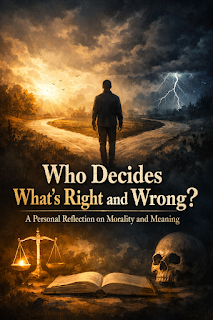

Who Decides What’s Right and Wrong? A Personal Reflection on Morality and Meaning
Even as a child, I was fascinated by morality.
Not morality as a list of rules, but morality as an idea. We all grow up being told what’s right and what’s wrong — by parents, teachers, religion, culture, and later by the law. But I kept wondering: who actually decides these things? And more importantly, why do we follow them so unquestioningly?
Most people don’t ask that. They inherit morality the same way they inherit language or tradition. It’s just there. Normal. Fixed. But for me, it never felt that simple.
Watching the World From the Inside
I’ve always been an inward-looking person. Even in social spaces, I found myself observing more than participating — watching how people behave, what they praise, what they punish, and what they quietly tolerate.
Society runs on invisible rules.
Some are written. Most aren’t.
You’re rewarded for fitting in, for wanting the “right” things at the “right” time. Education. Career. Marriage. Status. Respectability. And if you deviate too much, even quietly, you feel it — in raised eyebrows, subtle judgment, or outright rejection.
I noticed early on how morality often blends into social control. What’s considered “wrong” isn’t always unethical — sometimes it’s just inconvenient, uncomfortable, or threatening to the status quo.
That observation stayed with me.
Drifting Without Losing the Question
There were periods where I drifted. Times when I didn’t have a clear direction, where I looked like I was falling behind or wasting time. From the outside, it probably seemed like confusion.
But internally, I was searching.
I wasn’t trying to escape responsibility or meaning — I was trying to define them for myself. And that process isn’t neat. It doesn’t follow a straight line. It involves doubt, contradiction, and sitting with uncomfortable questions longer than most people are willing to.
One question kept resurfacing, no matter how much I tried to ignore it:
What do I actually want?
Not what would impress people.
Not what would make my family comfortable.
Not what society says is respectable.
What I want.
The Fear of Asking “What Do I Want?”
This question sounds simple, but it’s not. For many people, it’s terrifying.
Because once you ask it honestly, you risk discovering that your desires don’t align with the script you were handed. You might realise you’ve been living on borrowed values. That some of the things you’ve been chasing were never truly yours.
And then what?
Society doesn’t prepare us for that moment. There’s no roadmap for building a life that reflects your inner truth instead of external approval. So most people avoid the question entirely. They stay busy. They stay distracted. They stay compliant.
I didn’t want that.
Morality Beyond Rules
This is where morality came back into the picture for me — not as obedience, but as responsibility.
If no external authority can fully answer what’s right or wrong for my life, then I have to take ownership of my choices. That means I can’t hide behind “this is just how things are done” or “everyone does it.”
It means asking harder questions:
Am I living honestly?
Am I causing harm — to others or to myself — just to belong?
Am I choosing comfort over integrity?
This kind of morality isn’t loud. It doesn’t show up as virtue signalling or moral superiority. It’s quiet, internal, and often inconvenient.
But it’s real.
A Meaningful Life, On My Own Terms
I don’t want a life that only looks good from the outside. I want one that feels aligned on the inside — even if it’s misunderstood, slower, or less conventional.
Meaning, for me, isn’t found in ticking boxes. It’s found in intentional living: knowing why I choose what I choose, and being willing to stand by it.
That doesn’t mean rejecting society entirely. We all exist within systems. But it does mean engaging with them consciously instead of blindly.
Still Becoming
I don’t have final answers. I’m still becoming. Still questioning. Still refining what matters to me.
But I’ve learned this much: a meaningful life starts the moment you stop outsourcing your values.
Call it existential. Call it self-awareness. Call it resistance.
For me, it’s simply this — asking “What do I want?” and having the courage to live with whatever that answer reveals.